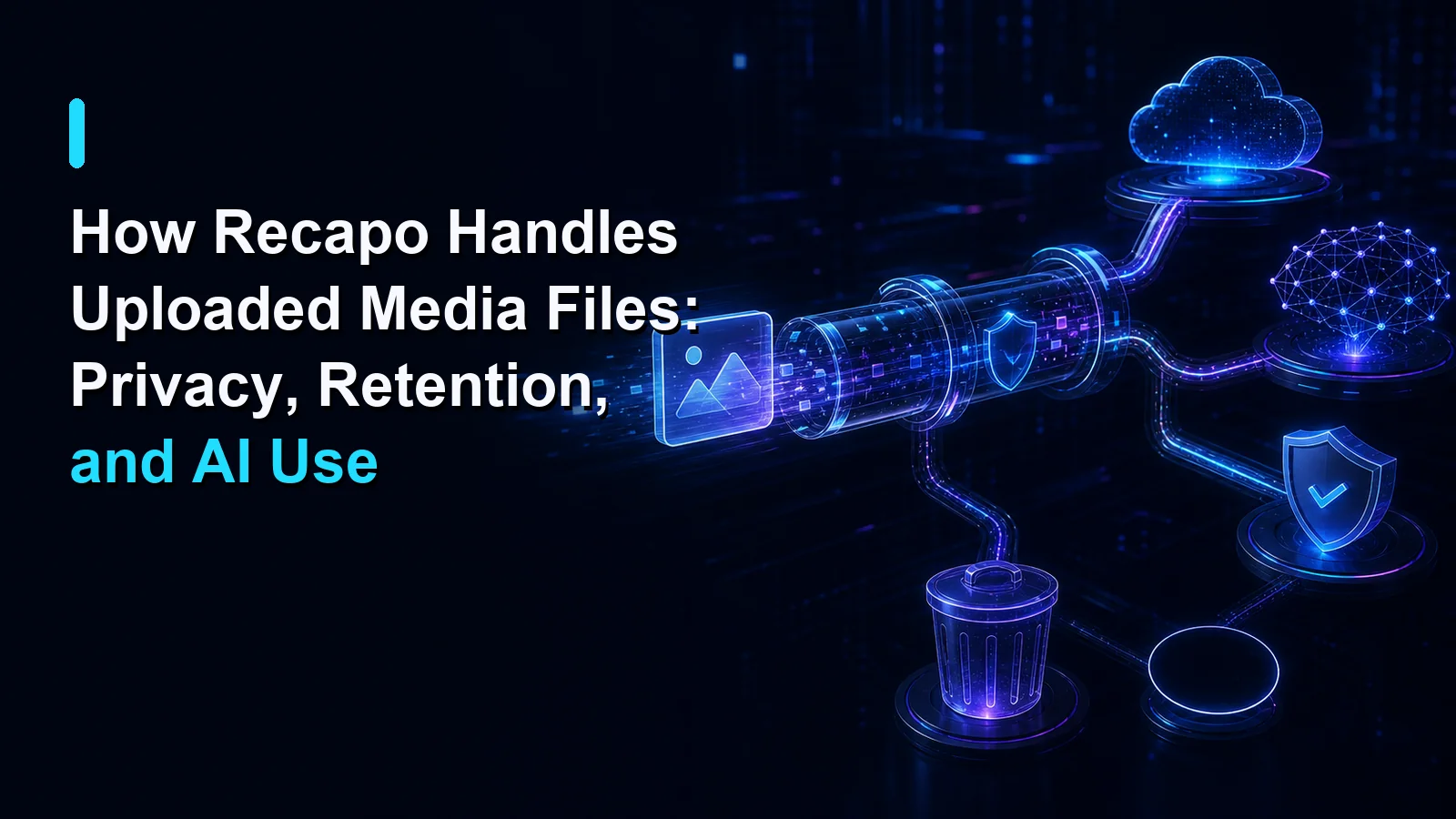
How Recapo Handles Uploaded Media Files: Privacy, Retention, and AI Use
Review Recapo's public disclosures on uploaded media, retention, model training, deletion requests, service providers, and undisclosed details.
By Recapo Editorial Team · Updated 2026-07-28
Disclaimer: This article provides general product and operational information and does not constitute legal advice. Copyright requirements and platform rules may vary by country, region, and platform. Before processing, modifying, or publishing a video, confirm that you have the necessary rights, authorization, and permissions.
Review status: This article reports what Recapo's public Privacy Policy, Terms of Use, and product pages disclose as of July 28, 2026. Privacy and security review is recorded without displaying individual reviewer names. Items that are not public are labeled clearly rather than inferred.
Online media tools process files that may contain faces, voices, business information, unpublished creative work, or other sensitive material. Users should be able to understand what happens after they choose a file—not only what the tool creates.
This page summarizes the current public disclosures about upload, processing, storage, model training, service providers, and deletion requests. It does not invent technical architecture, retention periods, or deletion guarantees that Recapo has not published.
 Recapo public disclosures for uploaded files, AI use, retention, and deletion requests.
At a glance
| Question Verified Recapo answer |
| Is transfer encrypted? | Recapo publicly states that it uses commercially reasonable technical and organizational safeguards, but it does not publish the encryption protocol, scope, or an end-to-end encryption claim. |
| Where is uploaded media processed? | Specific cloud regions and data-center locations are not published. The Privacy Policy states that information may be transferred to and processed outside the user's jurisdiction. |
| Is media stored after processing? | The policies allow Recapo and service providers to store and process uploaded content and related data, but they do not publish storage behavior separately for every tool or job stage. |
| What is the retention period? | No fixed number of days is published. Personal data is retained for as long as necessary for the stated purposes, unless a longer period is required or permitted by law. |
| What triggers automatic deletion? | Automatic deletion triggers and timing for source files, outputs, backups, and logs are not publicly specified. |
| Can a user request deletion? | Where available, users may manage certain content through account settings or request privacy rights by contacting [email protected]. The public policy does not specify a guaranteed completion time. |
| Which service providers process files? | The Privacy Policy lists provider categories, including cloud hosting, infrastructure, storage, analytics, security, AI, speech-to-text, text-to-speech, voice, dubbing, and audio processing. It does not publish a named subprocessor list. |
| Is uploaded media used to train models? | Yes. The current policies allow User Content, Input, Output, voice/audio information, and related or derived data to be used to train, develop, test, evaluate, and improve Recapo and affiliate models and services, subject to applicable law and any settings or features Recapo makes available. No specific opt-out workflow is publicly documented. |
1. Selecting and uploading a file
When a user selects a media file, the interface should explain:
- supported formats;
- maximum file size and duration;
- whether the file stays in the browser or is uploaded;
- why the file is needed;
- where the relevant privacy information can be found.
The main Recapo editing workflow publicly lists MP4, MOV, MKV, MPEG, MPG, and 3GPP, with up to 20 videos and 6GB total per upload. Some standalone tools also list WebM, 3GP, and 3GPP, with limits commonly shown as 2GB per file and 180 minutes per video. Limits vary by tool, so users should check the current upload panel before selecting a file.
Recapo's public policy describes commercially reasonable safeguards but does not publish a specific encryption protocol or claim end-to-end encryption. Users should not interpret HTTPS access to the website as proof of an unpublished end-to-end protection model.
2. Processing the media
Depending on the selected tool, Recapo may upload a video, audio file, subtitle file, prompt, or other input; process it with editing, transcription, generation, moderation, or safety systems; and return an output such as a video, subtitle file, transcript, or audio file.
The public policies do not name the cloud region, data center, complete automated model chain, or rules governing employee access to production files. They do state that third-party AI, infrastructure, storage, speech, voice, and audio providers may process content to provide, support, secure, debug, maintain, and improve the service.
3. Temporary storage and retention
Recapo does not currently publish a fixed retention schedule for each workflow. The table below records the limits of the public disclosure rather than presenting an assumed deletion promise.
| Workflow or file type Storage location Retention period Automatic deletion trigger Exception |
| Uploaded source file | Not publicly specified | As long as necessary for the stated purposes; no fixed period published | Not publicly specified | Longer retention may be required or permitted by law |
| Generated output | Not publicly specified | No output-specific fixed period published | Not publicly specified | May be affected by account or product settings where available |
| Transcript/project data | Not publicly specified | Covered by the general necessity-based retention statement | Not publicly specified | May include derived information used for service, safety, debugging, evaluation, or improvement |
| Failed job artifact | Not publicly specified | Not publicly specified | Not publicly specified | Not publicly specified |
| Support/debug copy | Not publicly specified | May be retained as necessary for support, debugging, safety, or legal compliance | Not publicly specified | Longer retention may be required or permitted by law |
The public policy does not provide backup deletion periods, log retention periods, or disaster-recovery deletion timing.
4. Downloading the result
Recapo's public pages do not specify a standard download-link lifetime, whether every link is access-controlled, whether links may be forwarded, or what happens after expiry. Users should download and verify important outputs promptly and retain their own authorized copy.
5. Automatic deletion
Recapo has not publicly documented the event that starts an automatic-deletion timer, the normal deletion time, systems covered, backup delays, failure handling, or monitoring responsibility. Until an approved retention schedule is published, this page should not state that every uploaded file is automatically deleted after a particular number of hours or days.
6. User-requested deletion
Where a relevant product feature is available, users may manage or delete certain uploaded or generated content through account settings. Users may also contact [email protected] to exercise privacy rights. The Privacy Policy states that rights may include access, correction, deletion, objection, restriction, withdrawal of consent, and complaints to a data-protection authority, depending on location.
The public policy does not describe the identity-verification workflow, the information required to locate a particular job or file, or a guaranteed response or deletion-completion time.
7. Service providers and subprocessors
Recapo states that it may use providers for cloud hosting, infrastructure, storage, analytics, payment processing, customer support, security, content moderation, AI, machine learning, speech-to-text, text-to-speech, voice generation, dubbing, and audio processing.
No public page currently names the complete provider list, processing regions, or a standalone subprocessor register. Users who require vendor-level due diligence should request the applicable information before uploading regulated or confidential media.
8. Model training and product improvement
The current Privacy Policy and Terms of Use allow uploaded content, outputs, voice/audio information, transcripts, metadata, and derived data to be used to train, develop, enhance, test, evaluate, and improve Recapo and affiliate models, algorithms, datasets, safety systems, and related services, where permitted by law.
The policies refer to applicable account settings or product features, but they do not publish a specific procedure for opting out of model training. Operational processing and model improvement are separate purposes and should be evaluated separately when deciding what to upload.
9. Security controls
Recapo publicly states that it uses commercially reasonable technical and organizational safeguards. It also says that no internet or email transmission is completely secure. The public policy does not specify encryption-at-rest design, access-control roles, job isolation, employee access approval, vulnerability-management cadence, incident-response commitments, or audit certifications.
10. Choosing what to upload
Even with strong controls, users should make a deliberate choice. Do not upload a file when:
- you do not have permission to process it;
- a contract prohibits using an external service;
- the file contains regulated or highly sensitive information that the service is not approved to handle;
- your organization requires a specific vendor review or agreement that has not been completed.
For business or regulated use, confirm organizational requirements before uploading.
Frequently asked questions
How long does Recapo keep uploaded files?
Recapo does not publish a fixed number of days. Its Privacy Policy uses a necessity-based standard and allows longer retention where required or permitted by law.
Can I delete a file before automatic deletion?
Where available, users may manage certain content through account settings. Privacy-rights requests can be sent to [email protected]; no guaranteed completion time is published.
Does Recapo use uploaded media to train AI models?
Yes. The current policies allow uploaded content, outputs, transcripts, audio/voice data, and related or derived information to be used for model and service training, development, testing, evaluation, and improvement, subject to applicable law and available settings or features.
Where is my media processed?
Specific regions and named subprocessors are not publicly disclosed. The Privacy Policy states that information may be processed outside the user's jurisdiction and identifies categories of service providers.
Who can access uploaded files?
The public policies do not describe employee access rules, approval requirements, or production-access logging.
What should I do if I uploaded the wrong file?
Use an available account deletion control if one is shown for the content, and contact [email protected] promptly. The public policy does not promise immediate deletion from every system.
Keeping this page accurate
This page should display its last verified date and a material-change log. Review it whenever Recapo changes infrastructure, models, subprocessors, retention periods, account behavior, privacy terms, or deletion controls.
| Date Change Owner approval |
| 2026-07-28 | Public-policy and product-page facts verified; undisclosed items labeled explicitly | Recapo Editorial Team; internal privacy and security review |
CTA: Review the privacy details for the specific tool, then upload only media you are authorized and comfortable to process.
Related Recapo pages
- Privacy Policy
- Terms of Use
- AI Video Editor
- Video Compressor
- AI Caption Generator for Video
- Extract Audio from Video
References
- Recapo Privacy Policy, last updated March 31, 2026
- Recapo Terms of Use, last updated March 31, 2026
- Recapo Data Processing Agreement — not publicly linked as of July 28, 2026
- Recapo Subprocessor List — not publicly linked as of July 28, 2026